Nvidia isn’t just building chips anymore, it’s building the infrastructure for a world where everything that moves thinks for itself. From robotaxis rolling through Los Angeles to data centers orbiting Earth, the company’s ambitions in early 2026 are reshaping what “computing platform” even means. CEO Jensen Huang put it plainly: “We are now a computing platform that runs all of AI.” That’s not a boast; it’s a business roadmap.
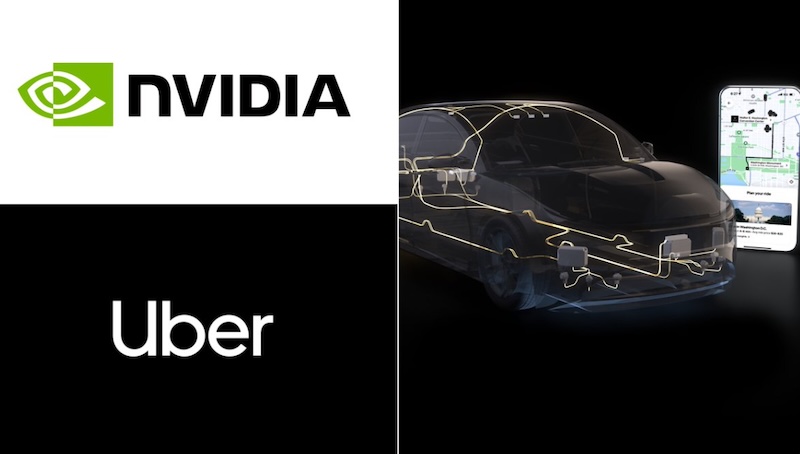
Nvidia and Uber have announced an expanded partnership to deploy a fully autonomous vehicle fleet across 28 cities and four continents by 2028. Rollout starts in Los Angeles and San Francisco in the first half of 2027, running on the full-stack NVIDIA Drive AV software.
This isn’t a pilot program — it’s a scaled commercial bet. Fleet will leverage NVIDIA’s Drive Hyperion platform alongside the Alpamayo open model portfolio and the NVIDIA Halos operating system, all designed to make level 4 autonomy both safe and scalable. Automakers are already buying in: BYD, Geely, Isuzu, and Nissan have each committed to Drive Hyperion for their own level 4 programs.
January, 2026, Mercedes-Benz CLA integrates Nvidia’s complete technology stack, from cloud GPU training clusters to in-vehicle compute — into a production vehicle. That’s a meaningful milestone. Uses NVIDIA Omniverse and the Cosmos world model for simulation, while in-car hardware runs a pure-vision setup on a single Orin chip paired with Nvidia’s own operating system and driving models.
Nvidia also upgraded its Alpamayo suite to version 1.5, adding an interactive, steerable reasoning model to its existing portfolio of AI models, simulation frameworks, and physical AI datasets. The goal: transparent, reasoning-based AV systems that don’t treat safety as an afterthought.
Not content with terrestrially autonomous vehicles, Jensen revealed Nvidia is developing the Vera Rubin Space-1, a chip and computer system designed for orbital data centers. Engineering challenge is considerable: space eliminates conduction and convection cooling entirely, leaving only radiation. Nvidia’s engineering teams are actively working through it.
Jensen projects at least $1 trillion in revenue by 2027, citing computing demand he expects to surpass even that figure. If the autonomous vehicle revolution is the destination, Nvidia’s clearly already in the driver’s seat.
Related Post
NVIDIA Alpamayo vs Tesla FSD: The Autonomous Driving Battle Heats Up
NVIDIA Alpamayo vs Tesla FSD: Development Kit Can’t Challenge Production Leader
Nvidia Partners with Palantir and Uber on AI Infrastructure for Autonomous Driving