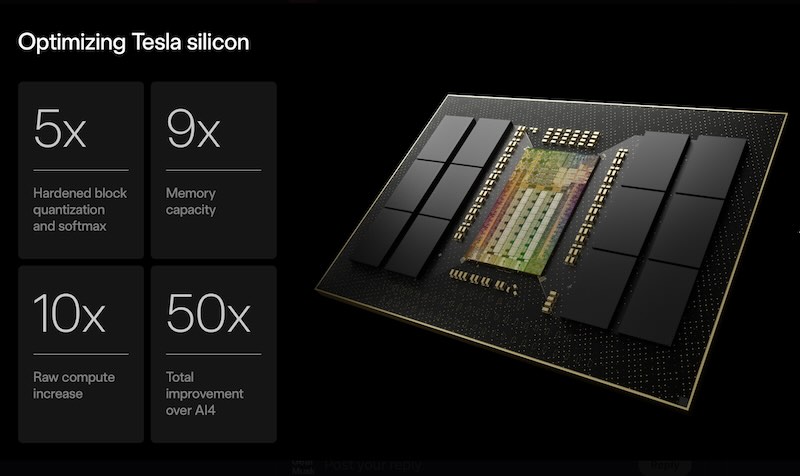
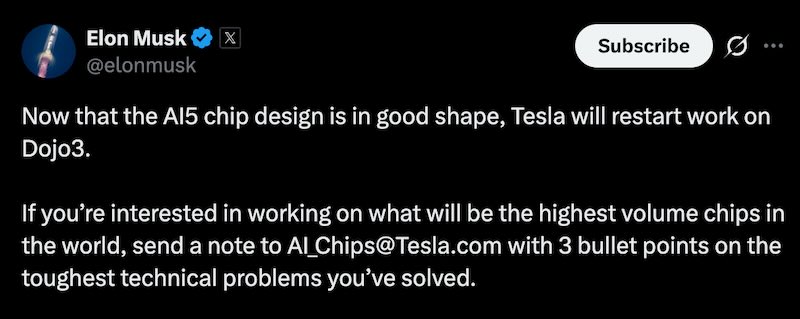
Tesla is bringing back its ambitious supercomputer project. Elon Musk announced that Tesla to restart work on Dojo 3 following successful progress on the company’s AI5 chip design.
When Tesla paused its dedicated Dojo team in mid-2024, industry observers quickly labeled the project a failure. That assessment missed the mark entirely.
Real issue wasn’t Dojo, it was AI5. Chip serves as the foundation for Full Self-Driving, Cybercab, and Optimus. By late 2024, Elon acknowledged publicly that AI5 wasn’t meeting requirements. If that chip failed, Tesla’s entire autonomy roadmap would collapse with it.
The company faced a resource allocation problem. Engineering teams were split between two separate chip architectures: one for real-time vehicle and robot processing, another for massive-scale AI training. Dual-track approach created inefficiencies Tesla couldn’t afford while AI5 remained unresolved.
Elon explained the severity plainly: “Solving AI5 was existential to Tesla, which is why I had to focus both the teams on that chip and I’ve personally spent every Saturday for several months working on it.”
Now that AI5 design issues are resolved, (AI5 chip targets 250W power consumption, production 2027), Tesla to restart work on Dojo 3 makes strategic sense. The company is no longer pursuing separate chip families for training versus inference.
Instead, Tesla is converging on a unified silicon architecture. Future chips like AI6 will power individual vehicles and robots while scaling into massive clusters for data center training. Dojo 3 will likely build on this shared foundation.
This approach represents a fundamental departure from industry norms. Most companies treat training compute as an operational expense, leasing capacity from Nvidia indefinitely. Tesla is building vertically integrated compute infrastructure spanning training systems, inference hardware, vehicles, and robots.
Elon’s recruitment post emphasized the scale: these will be “the highest volume chips in the world.” That’s not hyperbole when you’re shipping silicon in millions of cars, potentially millions or billions of robots, plus the training systems supporting them.
Clive Chan, who previously led Dojo workload development at Tesla, offered perspective on the restart. “Dojo1 was ultra ambitious and really pushed a lot of technologies (packaging, power delivery, system design, clock distribution, even number formats), but execution and focus could’ve been better.”
He added that if Dojo 3 reflects concepts discussed internally years ago, “it’ll be nuts.”
Elon’s response was brief but telling: “Yes on all counts. Has to be done to scale space AI.”
AI5 chip reportedly delivers Hopper-class performance as a single system-on-chip and Blackwell-class performance in dual configuration, while costing substantially less and consuming less power than competing solutions.
With that bottleneck cleared, Tesla can pursue parallel development again. Elon has repeatedly suggested the company will need to build a “Terafab” to manufacture the volume of chips required for its roadmap.
For engineers interested in the hardest technical challenges in custom silicon, Musk’s recruitment pitch is straightforward: send three bullet points on the toughest technical problems you’ve solved to Tesla’s hiring team.
Because when Tesla to restart work on Dojo 3, they’re not just building another training computer—they’re architecting the compute backbone for autonomous everything.
Related Post
Tesla AI5 Chip Production Starts 2027: 40× Faster Performance, Elon Confirms Timeline
Tesla Dojo Shift: Synthetic Data Powers Next-Gen FSD Training Strategy
Tesla Giga Texas Cortex 2: 500MW GPU Cluster Coming Mid-2026