For years, in-flight Wi-Fi was the kind of service passengers tolerated rather than relied on. Buffering videos, failed video calls, and speeds that barely qualified as broadband defined the cabin internet experience. That’s changing — fast. Starlink’s newest aviation technology is reshaping what passengers and airlines can expect from connectivity at 40,000 feet, and the numbers behind it are hard to ignore.
SpaceX’s Starlink announced that its latest aviation kits can deliver up to 1 Gbps per terminal, with multi-gigabit connectivity capable of serving an entire aircraft simultaneously. The company’s global head of aviation, Nick Seitz, framed it plainly: this is the first time commercial aircraft have been fitted with systems capable of exceeding 2 Gbps in aggregate bandwidth. That’s not a marginal improvement — it’s a generational shift.

Emirates is the launch partner for this milestone, deploying the next-generation In-flight Wi-Fi across its Airbus A380 fleet. The A380, capable of seating 500 to 600 passengers, presents a unique infrastructure challenge. To meet it, Emirates installed three Starlink antennas on each aircraft — an industry-first configuration, alongside additional wireless access points to ensure seamless coverage across both decks. Result is more than 2 Gbps of total aircraft bandwidth, and a connectivity experience the airline has described as better than what most passengers get at home.
What makes the Emirates deployment particularly significant is its scope. More A380s are scheduled for accelerated installation throughout 2026, with the service offered complimentary across all cabins. Planned enhancements include live TV streaming, initially through personal devices and later integrated into seatback screens.
It’s worth noting that Starlink doesn’t have this space entirely to itself — Amazon’s Project Kuiper (also referenced as Amazon Leo) has announced deals with both Delta and JetBlue. Its antenna promises up to 1 Gbps downloads and 400 Mbps uploads. But there’s a critical timing gap: Kuiper’s service isn’t expected to arrive on planes until 2027 and 2028, following several delays.
In-flight Wi-Fi speeds provide a telling measure of this gap. An Ookla analysis covering more than 50 airlines found that all eight carriers exceeding 100 Mbps median download speed in the second half of 2025 were served by Starlink. Several of those airlines recorded median speeds above 300 Mbps. No other in-flight connectivity provider came close to triple-digit speeds, and no Starlink-served airline fell below the 100 Mbps threshold — even as the network continued to grow.
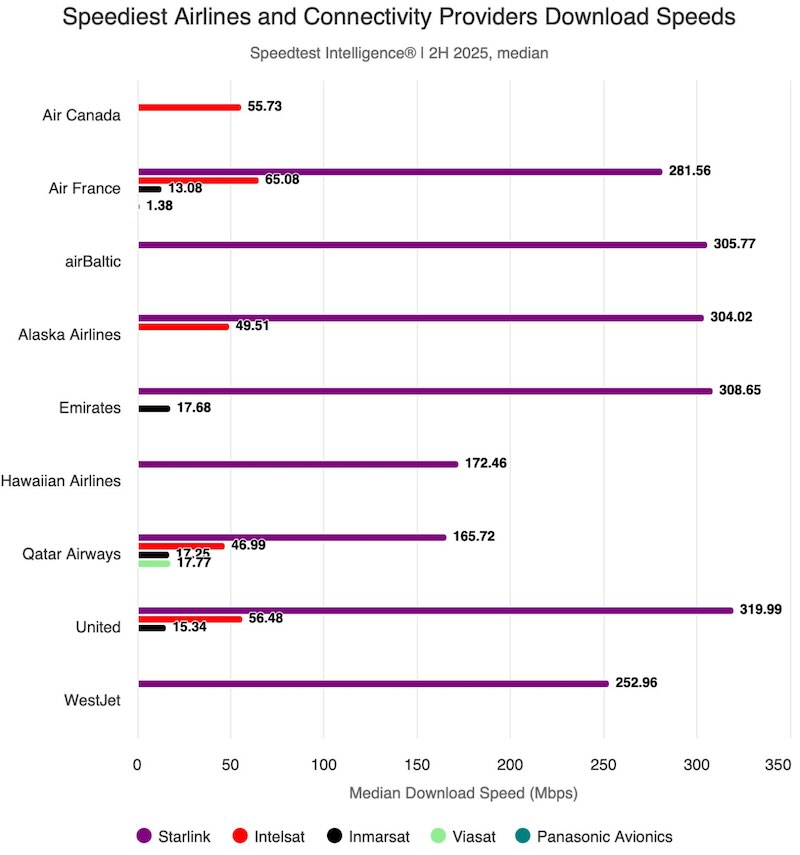
That consistency matters. Rapid network expansion often degrades performance as more users come online. Starlink has avoided that trend.
Business implications are becoming difficult to dismiss. Passengers are actively searching for flights based on Wi-Fi quality, and carriers without Starlink are increasingly at a disadvantage. Airlines like United, Alaska airlines, and Emirates have already made the transition, with more expected to follow.
For airlines still evaluating their connectivity strategy, the calculus is shifting. Starlink is already operational, already fast, and already setting passenger expectations that competitors will need years to match.
Related Post
Amazon Leo Aviation Antenna Takes Aim at Starlink In-Flight Wi-Fi Dominance
United Airlines Fixes Starlink Wi-Fi After Radio Interference
SpaceX Slams American Airlines Over Amazon Leo Talks, Starlink vs Leo Satellite Internet Battle