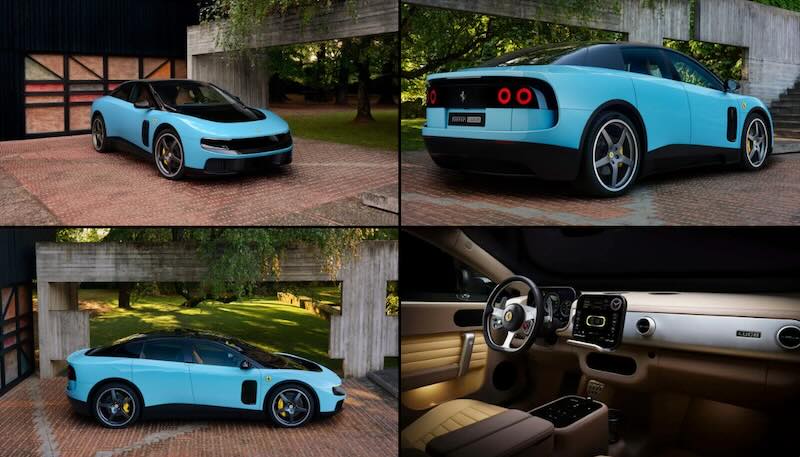
Ferrari has entered the electric vehicle market with a vehicle that challenges every assumption about what a battery-powered supercar should look like. The Ferrari Luce, unveiled this week, represents the company’s first production EV, it’s already generating controversy before a single unit reaches American driveways in Q2 2027.
Ferrari Luce delivers 1,050 horsepower through four electric motors, launching the four-door sedan from 0-60mph in 2.4 seconds. Its 122 kWh battery provides an EPA-estimated 280 miles of range while supporting 350kW peak charging speeds through an 800-volt architecture. Front motors spin to 30,000 rpm, while rear units reach 25,500 rpm—numbers that demonstrate Ferrari’s commitment to performance engineering even without internal combustion.
At 197.6 inches long, the Ferrari Luce matches the Tesla Model S in length but weighs 4,982 pounds. Trunk offers 21.1 cubic feet of cargo space, marking the largest luggage capacity Ferrari has ever produced. Five torque delivery modes can be selected via steering wheel-mounted paddle shifters, giving drivers control over power application intensity.
Exterior styling has drawn immediate criticism, with observers comparing the profile unfavorably to mass-market EVs. Battery packaging constraints appear to have forced compromises in proportions—when a 122 kWh pack dictates vehicle architecture, engineering requirements often override aesthetic preferences. Ferrari chose to preview the interior first, which now makes sense given the exterior’s polarizing reception.
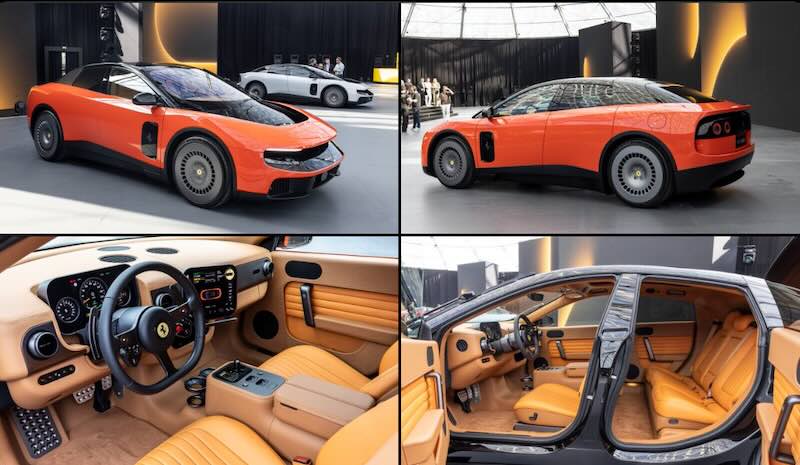
Jony Ive, Apple’s former head of design, co-designed the Ferrari Luce interior. His involvement signals Ferrari’s strategic decision to partner with established talent rather than develop digital experiences in-house. OLED screens dominate the cabin, reflecting modern expectations for connected vehicle interfaces.
The car employs an accelerometer system that captures vibrations from the electric motors and rear chassis. An algorithm filters unwanted frequencies while amplifying what Ferrari considers more musical sounds—audible both inside and outside the vehicle. This represents an attempt to manufacture emotional connection in an era where traditional engine notes have disappeared.
Ferrari maintains control over chassis dynamics and powertrain development while partnering externally for digital experience and broader design language. For a company with substantial financial resources, this approach suggests calculated risk management rather than desperation. $640k starting price positions the Ferrari Luce well above volume-market EVs, maintaining brand separation through pricing if not always through styling.
Can a four-door, four-seat electric Ferrari justify its premium when visual differentiation proves challenging? Answer may depend less on what the Ferrari Luce looks like and more on whether buyers find Luce in performance numbers alone.
Related Post
Porsche Taycan Turbo GT Manthey Kit Sets New Nürburgring EV Lap Record at 6:55.553
Lexus TZ All-Electric 3-Row SUV Unveiled — Range, Specs & US Release Date
Tesla Model S & Model X Plaid Signature Edition: 350 Exclusive Units at $159,420