SpaceX doesn’t do anything quietly, and naming its AI satellite constellation is no exception. Elon Musk has confirmed that Starmind will serve as the official name for SpaceX’s planned orbital AI data center network, a constellation that, if it reaches full scale, would put one million computing satellites into low Earth orbit. That’s not a typo.
Announcement follows a pattern that’s become unmistakable at SpaceX: every major initiative gets a “Star” prefix, building out what’s quietly become one of the most recognizable brand architectures in aerospace.
It’s worth taking stock of just how far this naming strategy extends. There’s Starlink, the internet constellation already operating over 10k satellites. Starshield serves as Starlink’s military counterpart, operating as a secured network for government and intelligence agencies. Stargaze handles orbital collision avoidance, tracking objects in orbit. Starfall will enable access to microgravity environments for scientific research and in-space manufacturing. Then there’s Starbase, SpaceX’s headquarters and development site in Texas — and Starfactory, its over one-million-square-foot advanced manufacturing facility located there. And, of course, Starship, the largest and most powerful rocket ever built.
Starmind slots directly into this lineup as the AI-compute arm of the business.
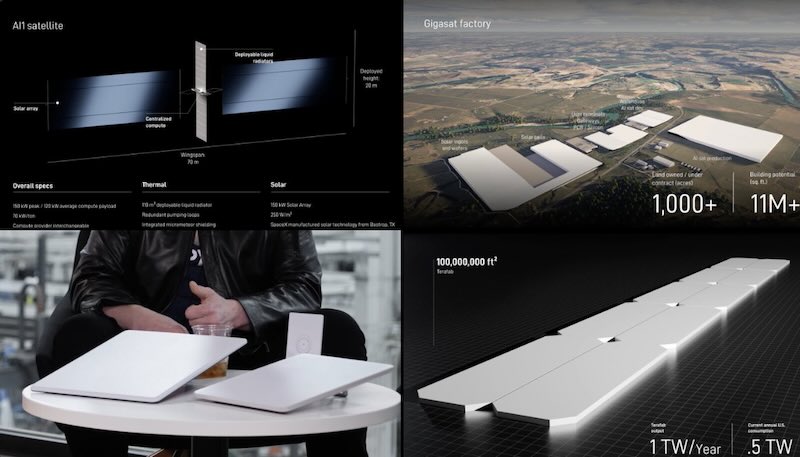
On January 30, 2026, SpaceX filed a request with the FCC to launch up to 1 million solar-powered satellite data centers into low Earth orbit, describing the system as “the most efficient way to meet the accelerating demand for AI computing power.” First hardware, called AI1, was unveiled on June 8. First-gen AI1 design stands 20 meters tall with a 70-meter deployed wingspan — wider than a Boeing 747-8.
Each satellite delivers 120 kW of compute on average and up to 150 kW at peak, placing it roughly on par with a modern AI server rack on the ground. Critically, the proposed constellation will connect to Starlink via high-bandwidth optical links, with Starlink then relaying data to ground stations.
SpaceX isn’t building this in isolation, either. On February 4, Elon announced that SpaceX had acquired xAI,merging his AI company into the rocket company — combining xAI’s Grok models and its Colossus supercomputer operations with SpaceX’s launch and satellite expertise under one roof.
Skeptics exist, OpenAI’s CEO called orbital data centers “ridiculous”, but SpaceX has already signed a $920 million-per-month compute agreement with Google, suggesting the market disagrees.
Related Post
SpaceX Buys Cursor for $60B: What It Means for AI Coding Tools
SpaceX Plans 100,000 Starlink Satellites: What It Means for Internet Future
SpaceX IPO Filing Reveals $28.5T TAM, Starlink Profits, Retail Access — What You Need to Know