
Tesla’s CyberCab has been a subject of ongoing speculation since the company first teased its robotaxi ambitions, but now it’s given the public something concrete: a partial look at the vehicle’s hardware architecture. The company has officially shared several design details about the CyberCab, and what’s emerged isn’t just a list of components, it’s a window into how Tesla’s engineering team thinks about redundancy, reliability, and the operational demands of an autonomous fleet.
What’s particularly striking isn’t any single feature in isolation. It’s the cumulative picture these disclosures paint about where Tesla thinks autonomous vehicle infrastructure actually needs to go.
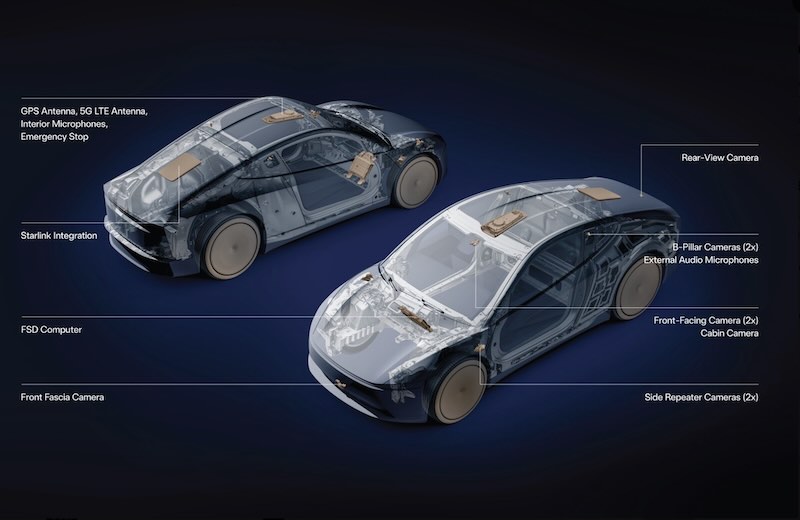
Among the disclosed details, one stands out immediately: the CyberCab carries both SpaceX’s Starlink V5 connectivity and a separate 5G antenna mounted at the front of the vehicle. That’s a dual-connectivity approach, and it’s not accidental.
Tesla’s Ashok Elluswamy addressed Starlink v5 integration directly, stating that it “is still not required for safe operation of the vehicle” and that “connectivity is primarily meant for navigation, customer service and, in general, fleet management.” That’s a careful, deliberate framing — but reading between the lines, it’s also an acknowledgment that the company is building toward something more.
Tesla Reveals Some Hardware Layout Details of CyberCab, and the dual-connectivity architecture may be the most commercially significant item on that list. Here’s the thing about connectivity in autonomous vehicles: it’s never been a hard requirement for safe FSD operation. But there are scenarios — think dense urban canyons, areas with strained LTE infrastructure, or regions with inconsistent 5G rollout — where a single bar of cellular just doesn’t cut it for dynamic rerouting.
Now, extrapolate that problem across a fleet. If future CyberCab deployments depend on real-time distribution of dynamic street data — potholes, road closures, live accident information — then a stable, always-on uplink becomes less of a luxury and more of an operational necessity. Starlink’s satellite coverage, particularly with v5 hardware, offers that stability wherever there’s a clear view of the sky.
Implication here isn’t subtle: this dual-connectivity setup could become a hardware requirement for future autonomous Tesla products, not an optional add-on.
This point also surfaces a broader truth that the industry sometimes glosses over: even the most capable on-device AI systems can’t anticipate every scenario they’ll encounter in the real world. Communication reliability in edge cases still requires extensive testing and validation. Tesla’s willingness to build in redundancy at the hardware level suggests the company understands that limitation clearly.
One detail that’s received less attention than it deserves involves the CyberCab’s external microphone. Rather than mounting it underneath the vehicle, a common approach in some current implementations, Tesla has integrated the microphone with the B-pillar camera module.
Reasoning here is functional. Emergency call recognition, including calls to services, depends on reliable audio capture. Positioning the microphone at the B-pillar provides better audio pickup performance for that use case. It’s an engineering decision grounded in practical acoustic logic rather than aesthetic preference.
This kind of detail reflects how Tesla’s hardware team approaches component placement: not as a packaging exercise, but as a performance optimization problem with real-world operational stakes.
Tesla Reveals Some Hardware Layout Details of CyberCab that also speak to the company’s approach to sensor minimalism. Surround-view camera configuration on the CyberCab uses only a front-mounted unit — there are no additional surround-view cameras on the left, right, or rear of the vehicle.
This is a deliberate choice that reflects Tesla’s engineering philosophy: components earn their place by delivering measurable value. If a sensor doesn’t meaningfully improve performance outcomes, it doesn’t go on the vehicle. That’s a principled position, and it’s one that Tesla has maintained consistently across its product lineup.
Where the CyberCab does differentiate from existing Tesla production vehicles is in its cleaning systems. All cameras on the CyberCab are equipped with cleaning mechanisms, a departure from current Model Y vehicles, which don’t include this feature across all camera positions. For a vehicle designed to operate continuously in a wide range of environmental conditions, that’s not a trivial addition. Dirty optics are a genuine operational risk for any vision-based autonomous system.
Taken together, these hardware disclosures tell a story about how Tesla is approaching the CyberCab not just as a vehicle, but as a node in a larger autonomous fleet infrastructure. Redundant connectivity, purpose-positioned audio hardware, camera configurations calibrated for operational efficiency, and system-wide cleaning capability, each element reflects an engineering team thinking about long-duration, high-reliability deployment at scale.
Dual-connectivity setup in particular deserves attention from anyone tracking the autonomous vehicle space. If Starlink becomes a standard component in Tesla’s robotaxi hardware stack, the implications for fleet communication architecture are significant. Real-time data sharing across vehicles — hazard locations, infrastructure changes, dynamic routing updates, becomes dramatically more reliable when each vehicle has a stable, low-latency uplink available.
None of this is fully operational yet. The company has been careful to note that these systems are still undergoing testing and validation. But the hardware decisions being made now are laying the groundwork for what Tesla’s autonomous fleet could look like at commercial scale.
Connectivity, it turns out, isn’t just about keeping passengers online — for the CyberCab, it’s about keeping the whole operation on the right road. And if these hardware reveals are any indication, Tesla isn’t taking that lightly. CyberCab’s architecture may be Cyber-serious about making every ride count.
Related Post
Tesla Cybercab Hits Austin Roads With No Wheel or Pedals
Tesla Cybercab Robotaxi First Responders Guide: What the Docs Reveal
Tesla Cybercab Production Begins: Robotaxi Miles Double in Q1 2026