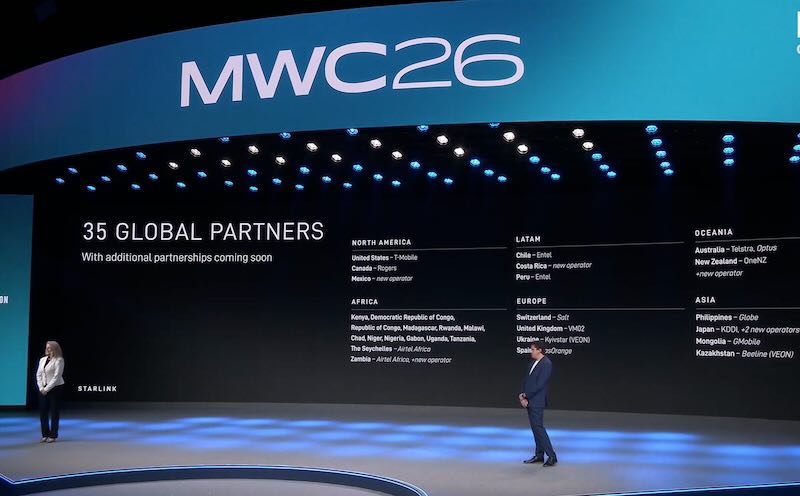
SpaceX dropped two major announcements this week that put the entire U.S. wireless industry on notice. Starlink Mobile is acquiring nationwide 800MHz spectrum, FCC has approved a next-gen satellite constellation of 15k spacecraft. Together, these moves signal that SpaceX isn’t experimenting, it’s constructing a full-scale mobile carrier with serious intent.
Well, Wall Street responded immediately. Shares of three major wireless carriers fell roughly 7% in after-hours trading, a reaction that underscores just how seriously investors are taking SpaceX’s long-term ambitions.

This is where it gets consequential. Not long ago, a major carrier’s chief executive publicly questioned whether Starlink Mobile could ever deliver reliable indoor coverage—specifically citing the inability to penetrate walls as a primary limitation.
That skepticism now looks premature. SpaceX confirmed it has reached an agreement to acquire nationwide 800MHz spectrum licenses, a lower-frequency band that travels farther and penetrates structures more effectively than higher-frequency alternatives. For consumers, means a signal could theoretically work inside a home, a basement office, or a rural structure where traditional satellite internet typically falls short.
This spectrum acquisition, once finalized by the FCC, would give SpaceX a meaningful terrestrial footprint to pair with its orbital infrastructure.
On the satellite side, FCC has approved SpaceX’s next-gen constellation of 15k spacecraft. That’s not an incremental upgrade. According to SpaceX, gen 2 satellites will deliver over 100x more bandwidth than the current gen, enough to support high-speed internet directly to standard smartphones without specialized hardware.
That distinction matters. Unlike earlier satellite internet services that required dedicated terminals or modified devices, SpaceX’s new constellation is designed to work with the phones consumers already own. If the bandwidth projections hold, the service could function as a genuine alternative to conventional mobile networks—particularly in rural and underserved markets where connectivity gaps remain persistent.
SpaceX’s broader architecture involves combining its satellite constellation with terrestrial infrastructure to create a seamless hybrid network. Outdoor coverage, indoor coverage, and cellular dead zones, SpaceX intends to serve all three from a single platform.
That’s an ambitious target, and execution will determine whether the vision holds. Still, between the spectrum acquisition and the satellite approval, SpaceX now holds two assets that incumbents have spent decades accumulating.
Incumbent carriers aren’t standing still, but a 7% after-hours drop suggests the market believes SpaceX has crossed a meaningful threshold, from credible experiment to serious competitor.
The wireless industry spent years waiting for satellite internet to become truly mobile. With these announcements, Starlink Mobile isn’t just on the move, it’s in orbit.
Related Post
AT&T, T-Mobile and Verizon Form Joint Venture to Counter SpaceX Starlink Mobile
SpaceX Gains 65 MHz for Starlink Mobile — But a $2.4B Escrow Condition Has EchoStar Pushing Back