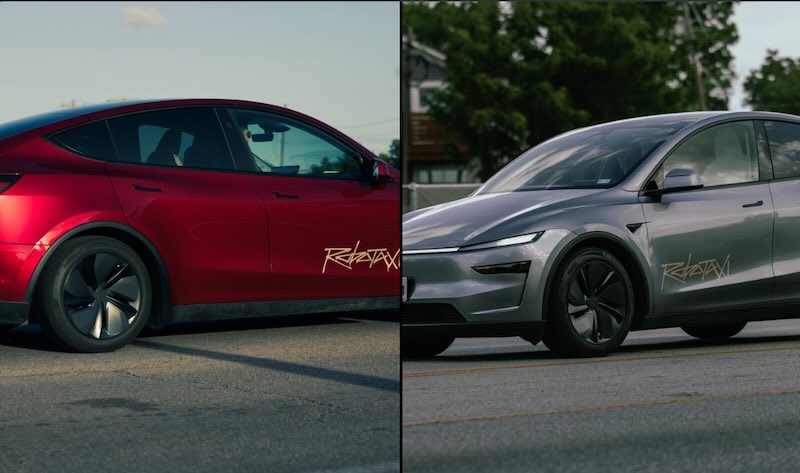
Tesla’s robotaxi ambitions aren’t just about autonomous vehicles—they’re about fundamentally reshaping transportation economics through manufacturing prowess. Analysis blog post from ARK Invest reveals Tesla’s Austin factory alone could produce more vehicles than urban Austin’s entire ride-hail fleet in approximately nine days, highlighting the company’s potential to flood markets with autonomous vehicles at unprecedented speed.
This production capacity doesn’t even account for Tesla’s planned Cybercab manufacturing (5-Second CyberCab Production), which targets 2-4 million units annually beginning next year. The implications for competitors and consumers alike are staggering, particularly when examining Tesla’s data collection advantages over established players like Waymo.
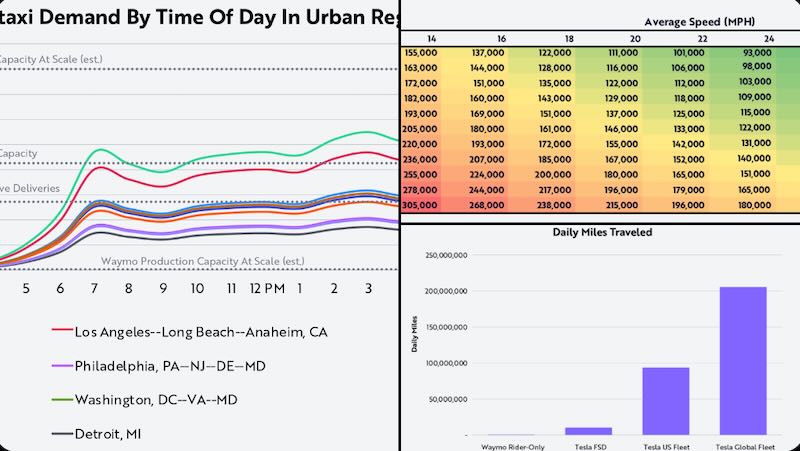
Tesla’s FSD vehicles generate approximately 40 times more real-world driving data daily compared to Waymo, while Tesla’s global fleet produces roughly 900 times more data overall. Massive information advantage provides Tesla with diverse geographical insights that enhance its AI’s capability to handle edge cases—scenarios that often challenge autonomous systems in unpredictable ways.
Unlike Waymo’s geofenced operational model, Tesla robotaxis benefit from data spanning various environments and conditions. Broader dataset should enable Tesla to scale operations more rapidly without requiring detailed mapping of every operational area, reducing deployment costs and timeframes significantly.
Tesla’s vertically integrated manufacturing approach provides substantial benefits over competitors who rely on partnerships. While Waymo depends on collaborations with Uber, Jaguar, Zeekr, and Hyundai for vehicle production and deployment, Tesla controls its entire supply chain and manufacturing process.
Current annual production capacity for Tesla’s Model 3 and Y vehicles could theoretically support the vehicle miles traveled (VMT) requirements of any top 10 US urban market. Production capability suggests Tesla robotaxis could rapidly saturate major metropolitan areas once regulatory approval is secured.
Research indicates that approximately 200k robotaxis, supplemented by privately owned vehicles integrated into fleets similar to Airbnb’s model, could meet all of urban Austin’s VMT demands. However, these projections remain sensitive to variables including average vehicle speed and deadhead miles—the distance traveled without passengers.
State-level regulations currently present deployment challenges, as evidenced by restrictions in markets like New York City. However, a potential shift toward federal regulatory oversight could serve as a catalyst for nationwide expansion. Federal standardization would eliminate the need to navigate varying state requirements, potentially accelerating Tesla robotaxis rollout across multiple markets simultaneously.
Tesla’s Austin (doubles coverage: 80 square miles) and San Francisco launches are already underway, providing real-world operational data that competitors can’t easily replicate. Early deployments offer Tesla three critical advantages: manufacturing scale, data collection superiority, and cost-per-mile efficiency.
Robotaxi market represents more than just autonomous vehicles—it’s about creating an entirely new transportation ecosystem. Tesla’s approach combines vehicle manufacturing, software development, and service operations under one corporate structure, eliminating many coordination challenges faced by partnerships.
Even Waymo has acknowledged that data and computational resources serve as key variables in enhancing autonomous vehicle performance. Tesla’s massive data advantage, combined with its manufacturing capacity, positions the company to potentially dominate not just US markets but global robotaxi deployment during the next several years.
The addressable market extends far beyond urban Austin, encompassing the entire US VMT opportunity. Tesla robotaxis could capture significant market share by leveraging production scale that competitors simply can’t match through traditional partnership models.
Related Post
Tesla Robotaxi Seeks Arizona Approval to Challenge Waymo in Phoenix
Tesla Robotaxi Review: FSD v13+ with Remote Intervention – Real Test Results
Tesla vs Waymo: Kyle Vogt Explains the Real Robotaxi Divide That Matters Most