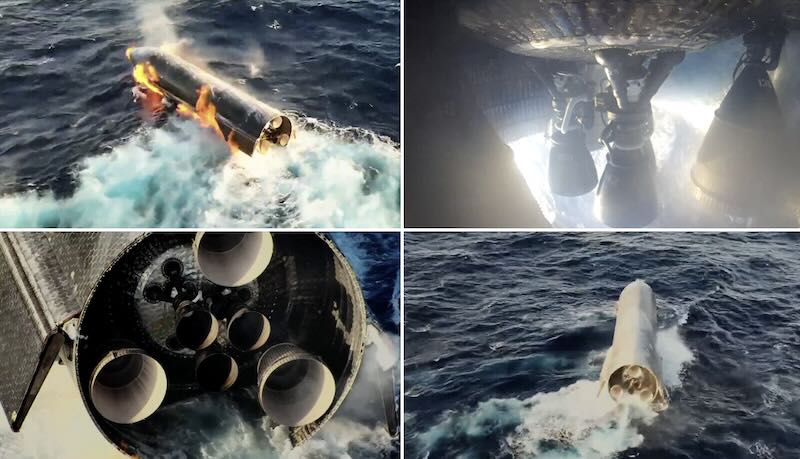
Starship Flight 13 lifted off from Starbase today, and by the time the dust settled over the Gulf, SpaceX had checked off nearly every box on its list. Super Heavy booster came back for a controlled landing offshore. The upper stage, known internally as Ship, deployed 20 next-gen Starlink satellites on a suborbital arc and then splashed down gently in the Indian Ocean. Nothing about this mission was guaranteed going in, given that the previous attempt on July 16 ended before the vehicle even left the pad. Flight 13 changed that story, and it did so on a mission that carried more riding on it than any Starship test before it.
Every Starship test flight carries its own set of firsts, but Flight 13 stacked several of them into a single 65-minute mission. This was only the second outing for the V3 configuration of Starship and Super Heavy, a redesigned vehicle that stands over 400 feet tall when fully stacked. It’s also considerably more powerful than the V2 hardware that flew before it, which matters once you consider what SpaceX asked this rocket to carry.
Stage separation went according to plan, with Ship igniting its own engines and pulling away from the booster in the hot-staging maneuver SpaceX has relied on since earlier flights. Engineers tweaked the sequence ahead of this launch after Flight 12 saw an uneven engine start that sent the booster tumbling in the wrong direction during its flip. This time, the flip executed cleanly, and Super Heavy moved into its boostback burn without the drama of prior attempts.
The booster’s landing burn brought it down for a controlled splashdown off the Texas coast, a result that stands in contrast to Flight 12’s rougher return. Meanwhile, Ship continued along its suborbital path toward the Indian Ocean, carrying a payload that made this flight matter well beyond the usual rocket-watching crowd.
Twenty satellites sat inside Ship’s payload bay for this flight, and none of them were dummy hardware. Every previous Starship mission that carried payload simulators used mass models built to mimic the shape and weight of a real satellite without any of the electronics. Flight 13 swapped those out for functional Starlink V3 units, marking the first time SpaceX has sent its next-gen satellite hardware to space aboard Starship.
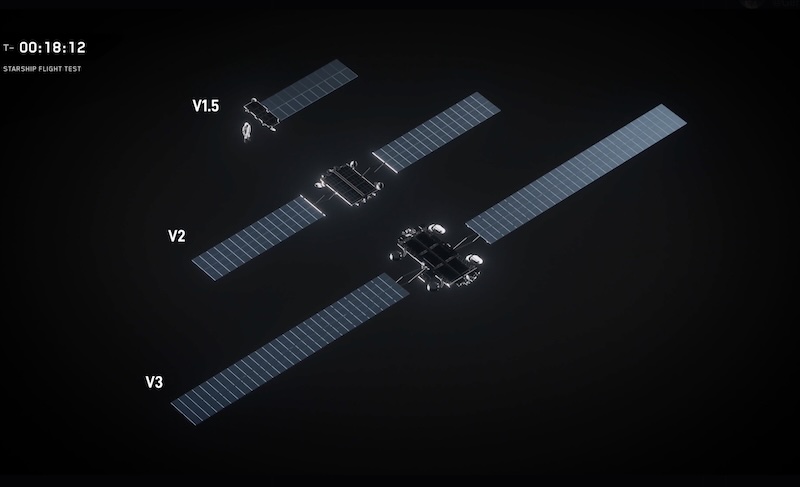
The satellites released through Ship’s slit-style dispenser door, a mechanism SpaceX has nicknamed for its resemblance to a candy dispenser. Once clear of the vehicle, each satellite extended its solar arrays and antennas, then attempted to establish contact with the broader Starlink network using inter-satellite laser links. 6 of the 20 units carried cameras aimed back at Ship, capturing footage of the heat shield tiles during the vehicle’s return through the atmosphere.
None of these satellites were meant to stay in orbit. Because Flight 13 flew a suborbital trajectory, the Starlink units followed the same path as Ship and burned up on reentry roughly 20 minutes after deployment. That window was short, but it gave engineers exactly what they needed. Michael Nicolls, SpaceX’s VP for AI and Starlink, posted on X following the deployment that the team had made contact with all 20 satellites using both RF and laser links, and had successfully pulled down key telemetry from each one before reentry.
That confirmation matters more than it might appear at first glance. Establishing a laser link between a freshly deployed satellite and an operational constellation isn’t a given, particularly on hardware flying for the first time. Getting all 20 units to respond, extend their arrays, and hand back telemetry gives SpaceX a real dataset to work from rather than a best guess based on ground testing alone.
A word of caution belongs here too. Nothing about Friday’s satellite deployment changes what current Starlink subscribers experience today. These were instrumented test articles on a short suborbital hop, not operational spacecraft joining the network. The jump from this test to noticeably faster home internet still depends on regulatory approval for the new satellite class and a launch cadence steady enough to build out a meaningful V3 fleet. Both pieces remain works in progress, regardless of how clean Friday’s test looked.
The interest in V3 hardware isn’t just about a new version number. SpaceX has said these satellites are built to support meaningfully higher data throughput than the V2 Mini units currently populating the constellation, with downlink capacity described as an order of magnitude beyond what customers get today. Uplink speeds see a similar jump. For a network that already carries a significant share of active satellites in orbit, a capacity increase at this scale would represent a genuine shift in what Starlink can offer, not a modest bump.
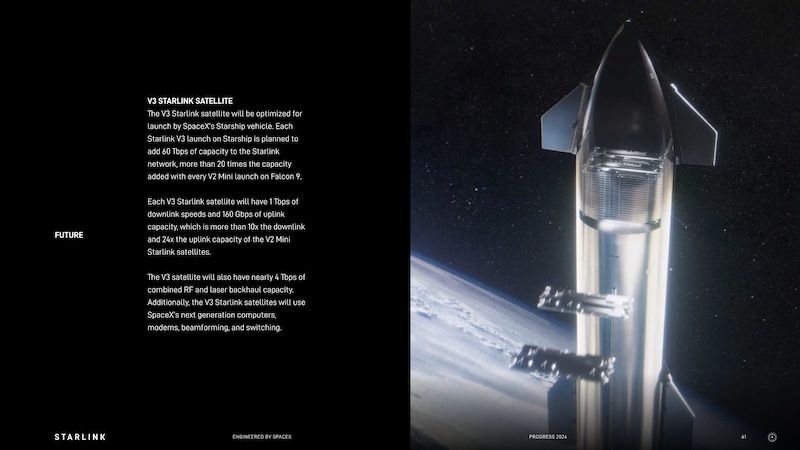
Getting there requires Starship to fly often and reliably, since the V3 satellites are heavier than earlier versions and were designed with Starship’s larger payload capacity in mind. Falcon 9 has carried the Starlink program for years, and it isn’t going anywhere soon. But the long-term plan calls for Starship to handle the batch launches that expand the constellation at the pace SpaceX wants. Friday’s test is a step toward that future, not the arrival of it.
Ship’s return to Earth drew as much attention as the satellite deployment itself. After completing an in-space relight of a single Raptor engine, a maneuver SpaceX considers essential for future orbital missions, Ship pressed on toward reentry. It survived the plasma phase of its descent without any visible issues, executed its flip maneuver, and came down in the Indian Ocean near a set of buoys equipped with Starlink terminals.
The splashdown itself stood out for how gentle it looked. Video from the buoys showed Ship settling into the water rather than breaking apart, and it stayed afloat long enough to keep transmitting live footage back to ground teams. A SpaceX spokesperson watching the feed called the outcome a dream scenario, and it’s easy to see why. Previous splashdowns in this program have ranged from rough to outright destructive. This one left the vehicle intact and still talking.
Elon weighed in shortly afterward, noting that the flight had produced more heat shield data than the team had anticipated going in. That data carries weight beyond this single mission. SpaceX has been refining Starship’s thermal protection system across several flights, testing different tile attachment methods and instrumenting some tiles to measure stress during reentry. A clean pass through the atmosphere, paired with a soft landing that kept cameras rolling, gives engineers a fuller picture of how those changes performed under real flight conditions rather than a partial one cut short by an early failure.
None of this means Starship is finished with its testing phase. SpaceX still needs to demonstrate a chopsticks catch of Ship itself, something it has so far reserved for the booster. Orbital missions, in-space refueling, and eventually crewed flights all sit further down the roadmap. But Flight 13 gave the program a mission where nearly everything worked as intended, on a test carrying more real hardware and more riding on the outcome than any flight before it.
Flight 13 will likely be remembered less for any single maneuver and more for how many pieces came together on one mission. A booster that landed under control. An upper stage that survived reentry cleanly and splashed down gently enough to keep filming itself. Twenty satellites that talked back. Taken individually, none of these results would have been shocking. Taken together, on a vehicle still working through its second flight in a new configuration, they add up to a genuinely strong outing.
The next real test for the Starlink V3 program won’t be another suborbital hop. It’ll be getting these satellites into actual orbit, then scaling up the number SpaceX can fly per mission until the constellation feels the difference. That’s still ahead. For now, Starship has earned itself a solid landing, and Starlink has earned itself a starting point.
Related Post
SpaceX Starship V3: Every Change, Explained Ahead of the May 19 Launch
SpaceX Starship Rocket Aces 11th Test Flight, Setting Stage for Version 3
SpaceX Unveils AI Satellites, New Starlink Terminals & Terafab Factory Plans