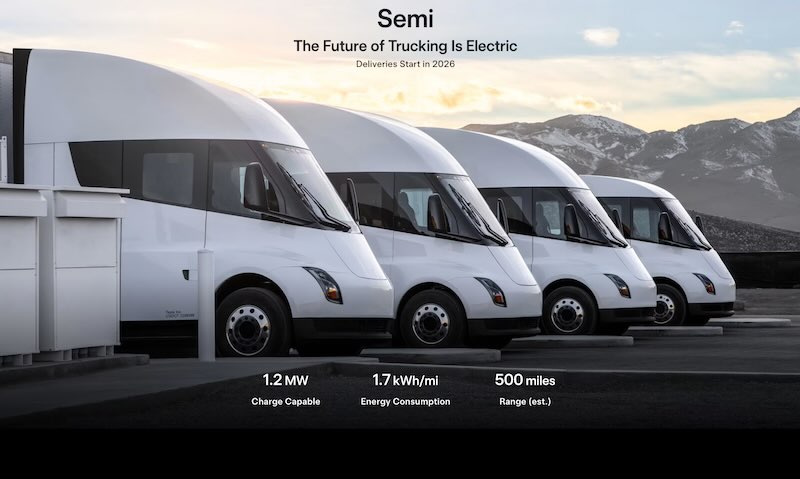
Tesla Semi has entered production. That single fact carries more weight than it might initially suggest, given that the truck was first shown to the public nearly a decade ago. 9 years is a long stretch for any vehicle program, and it raises an obvious question: what exactly was Tesla doing during all that time?
As it turns out, quite a bit. Rather than sitting on a shelf, Semi program moved in step with every major shift in Tesla’s passenger vehicle lineup. Motors changed. Battery chemistry changed. Thermal systems changed. By the time the truck reached its production form, it had effectively absorbed three separate generations of Tesla’s underlying technology platform.
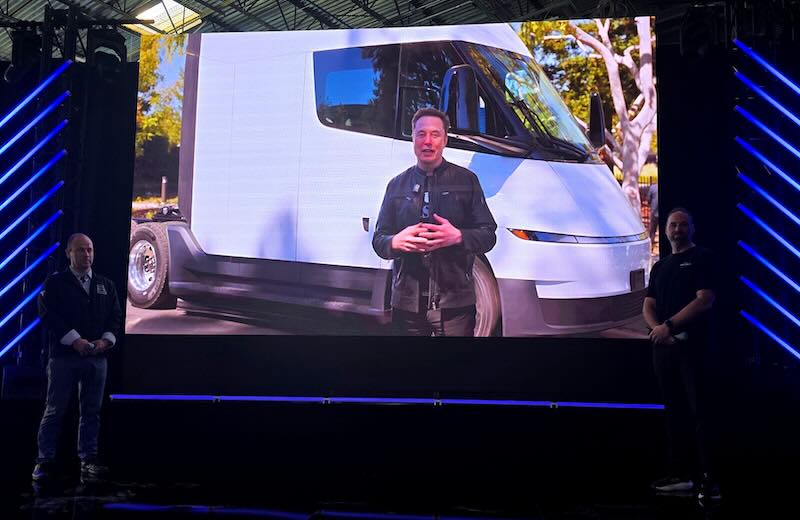
Original Semi concept relied on four motors borrowed from the Model 3. That setup didn’t last. By 2022, Tesla had shifted to a three-motor configuration derived from the Model S Plaid, pairing two front motors with a single rear unit. The production version keeps that basic layout, and for good reason, front motors handle low-end torque, while the rear motor manages cruising efficiency and can disconnect entirely when it isn’t needed.
Motors themselves look quite different under the surface, though. Tesla moved away from the carbon-fiber sleeve rotor used in the now-discontinued Plaid motors and adopted a steel squirrel-cage design instead. That switch brings lower cost, better reliability, and improved efficiency all at once. Stator, meanwhile, borrows hairpin winding technology already proven out through Cybertruck production, which means Tesla didn’t need to reinvent manufacturing processes from scratch.
Put together, these changes trimmed 80kg off the electric drive unit. For a vehicle this large, that’s a meaningful reduction, not a rounding error.
Curiously, peak power actually dropped over time. 2022 Semi claimed 1,500 horsepower, while the production version settles at 1,076 horsepower. Acceleration followed a similar pattern, original 0-100 km/h claim of 5 seconds has given way to 12.5 seconds unloaded, or 24 seconds under full load.
Is that a step backward? Not really, once you consider the comparison point. A fully loaded diesel semi can take close to a minute to hit the same speed. Tesla’s early acceleration numbers reflected a desire to make the truck feel like a passenger car, but feedback gathered from actual truck drivers, along with more than 27 million kilometers of fleet mileage, pointed toward a different priority entirely: ease of operation matters more than raw speed for commercial drivers.
Tesla Semi’s energy storage has changed just as dramatically as its motors. Early prototypes used 2170 cells built on the same line as Tesla’s Powerwall product. Production version switches to 4680 cells, rated for a design life of 1.6 million kilometers, packaged into a smaller overall footprint.
Physical layout is unusual, too. Rather than spreading one flat battery across the chassis, as most passenger EVs do, Semi splits its capacity across three separate packs. Winter testing led Tesla toward this configuration after engineers found it retained heat more effectively, reducing the energy needed to keep the pack within its target temperature range.
Voltage architecture shifted as well, moving from 400V to 800V on high-voltage side and from 12V to the Cybertruck’s 48V system on the low-voltage side. Thermal management underwent a full redesign too, adopting Tesla’s third-generation Supermanifold architecture, same system found in CyberCab, rebranded as Megamanifold for Semi applications. Tesla claims this system improves operating efficiency by 38%, which is not a trivial figure for a vehicle spending most of its life on the highway.
All told, these changes reduced production Semi’s weight by roughly 450kg while dropping energy consumption from around 2 kWh per mile to 1.7 kWh per mile.
Numbers matter quite a bit here. Standard battery pack holds 548 kWh, while the long-range version steps up to 822 kWh. Standard-range trucks are rated for approximately 520 km, and the long-range version can cover about 800 km at a fully loaded weight of 37 metric tons, or nearly 960 km when carrying half that load.
Charging speed matters just as much as range for fleet operators. Semi supports up to 1.2 MW of peak charging power, reaching 60% charge in roughly 30 minutes. That’s a fast turnaround for a vehicle this size, and it directly addresses one of the biggest concerns fleet managers raise about electric trucking: downtime.
Tesla estimates Semi can save fleet operators around $65k annually compared with diesel equivalents, with electricity costs accounting for most of that gap. Maintenance adds another layer of savings, Tesla claims the motors and differential share a common lubricant capable of running more than 400,000km without a change, compared to the 60,000 to 100,000km interval typical of diesel engines.
With production capacity set at 50k units annually, real test for Semi won’t be engineering anymore. It’ll be whether fleet operators find the total cost of ownership compelling enough to make the switch, and whether nine years of quiet, continuous refinement finally pays off on the open road.
Related Post
Tesla Semi European Version Unveiled: 550 km Range, Camera Mirrors & 2027 Deliveries
Tesla Semi FSD: What the New Ground-Truth LiDAR Sightings Actually Mean
Jay Leno Drives the Redesigned Tesla Semi — Here’s What He Found