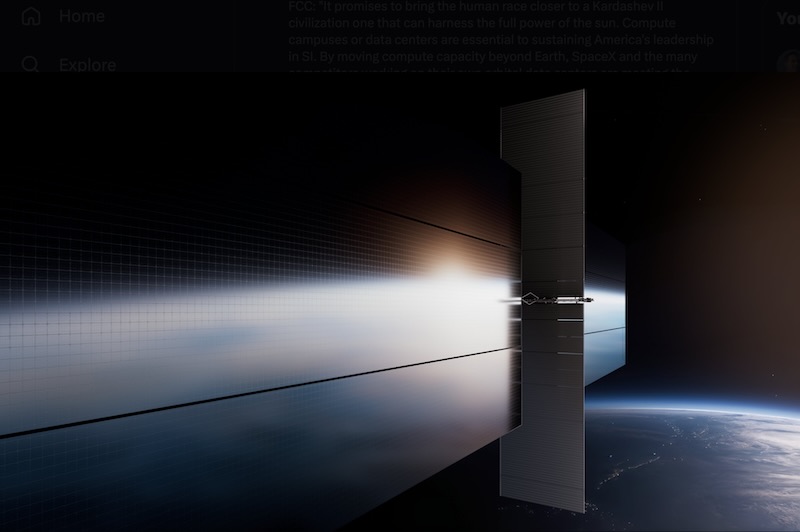
It’s not every day that a regulatory agency greenlights something that sounds like it belongs in a science fiction novel. Yet, that’s exactly what happened when the FCC officially authorized SpaceX to deploy up to 1 million satellites for Starmind, its orbital data center constellation. This isn’t a pilot program or a preliminary review. It’s a full authorization, and it’s the first of its kind in U.S. history.
For anyone tracking the intersection of space infrastructure and artificial intelligence, this moment carries serious weight.
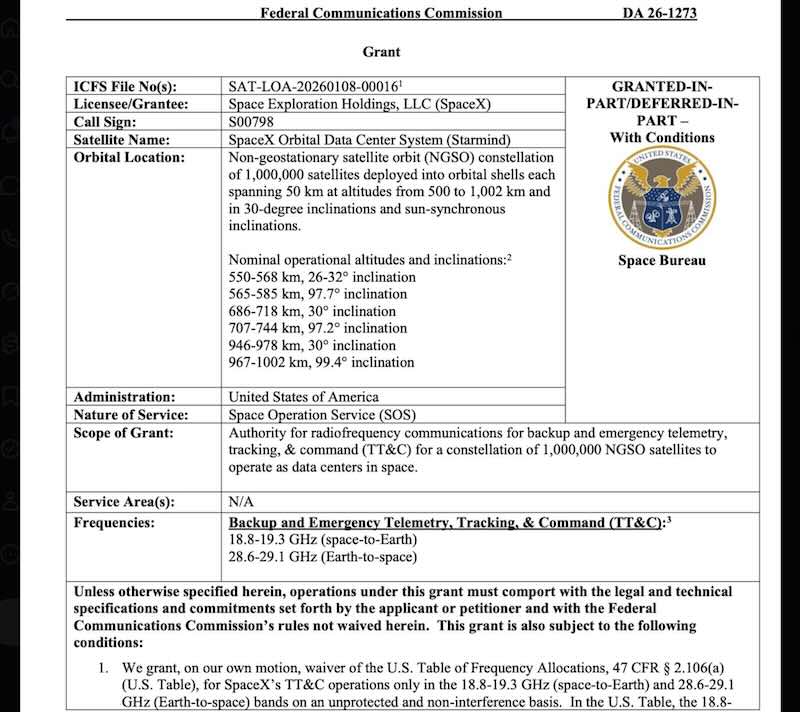
SpaceX’s Starmind isn’t a communications network in the traditional sense. It’s a compute platform, a constellation of satellites designed to function as data centers operating in low Earth orbit, between 500 and 1,002 kilometers above the planet’s surface.
Primary communications will route through optical laser links with existing Starlink satellites, with Ka-band frequencies reserved for backup and emergency use. License term runs 15 years, FCC has confirmed no further environmental review is required at this stage.
What makes the architecture particularly notable is its integration with an already-operational satellite network. SpaceX isn’t building Starmind in isolation, it’s layering orbital compute capacity on top of infrastructure that’s already handling global broadband connectivity. That’s a meaningful technical distinction.
FCC didn’t just approve this application. It made a statement. Commission described Starmind as a step toward what it called a Kardashev II civilization, a theoretical stage of technological development defined by the ability to harness the full energy output of a star. That’s an extraordinary framing for a regulatory filing.
Approval comes with binding deployment requirements. Under the FCC’s milestone schedule, SpaceX must have satellites operational by November of each respective year:
- 2033: 1 satellite
- 2035: 100,000 satellites
- 2038: 500,000 satellites
- 2040: 1,000,000 satellites
Before deploying any satellites above 600 km, SpaceX must also submit a finalized orbital debris mitigation plan. That’s a non-negotiable condition, and it signals the FCC’s awareness that a constellation of this scale introduces real environmental considerations for orbital space.
Not everyone was enthusiastic. Amazon Leo, Viasat, and the American Astronomical Society all filed petitions seeking to block SpaceX’s application. The FCC denied all three.
Opposition from the American Astronomical Society is worth noting beyond the legal outcome. Astronomers have raised consistent concerns about large satellite constellations interfering with ground-based observation, a tension that doesn’t disappear simply because a petition gets denied. As Starmind scales toward its million-satellite target, that conversation is going to resurface, and it’ll carry more urgency than it does today.
Viasat’s objection likely reflects competitive concerns more than scientific ones. Amazon is building its own orbital infrastructure with Project Kuiper, and the approval of a competitor’s data center constellation at this scale is a signal that the FCC is prepared to authorize orbital compute as a legitimate infrastructure category — not just for one company.
Here’s where Starmind becomes more than a SpaceX story. The FCC’s language about “competitors working on their own orbital data centers” suggests the commission views this as an emerging industry, not a single-company experiment.
Commission explicitly tied its approval to U.S. competitiveness in artificial intelligence. Moving compute capacity beyond Earth, where energy constraints and physical footprint work differently than on the ground, could reshape how AI infrastructure scales over the next decade. If orbital data centers prove viable at the numbers SpaceX is targeting, the economics of AI compute change fundamentally.
That’s a large conditional. But it’s also one that just received the most significant regulatory endorsement it could get in the United States.
Authorization is real, the milestones are aggressive, and the competitive landscape is shifting. Whether Starmind meets its 2040 target of 1 million operational satellites remains to be seen, FCC has decided the future of compute isn’t just on the ground. With Starmind, it seems the sky is no longer the limit, it’s the launchpad.
Related Post
SpaceX Buys xAI, Valued at $1.25T, Orbital AI Data Centers Planned
SpaceX Names New AI Clusters “Gun Range” and “Spam”, 420K GB300 GPUs Coming Online
SpaceX Unveils AI Satellites, New Starlink Terminals & Terafab Factory Plans