The orbital data center race just got a lot more crowded. Blue Origin has filed a formal request with the Federal Communications Commission to launch Project Sunrise — a constellation of up to 51,600 satellites designed to run AI and cloud computing workloads directly from low Earth orbit. Filing arrives just two weeks after Amazon urged the FCC to reject SpaceX’s far more ambitious 1-million satellite proposal, calling it too speculative and potentially monopolistic.
Blue Origin’s vision isn’t modest. The company is requesting authority to operate satellites across sun-synchronous orbits ranging from 500km to 1,800km above Earth. Each satellite would draw on constant solar exposure — a key differentiator in the pitch to regulators and investors alike.
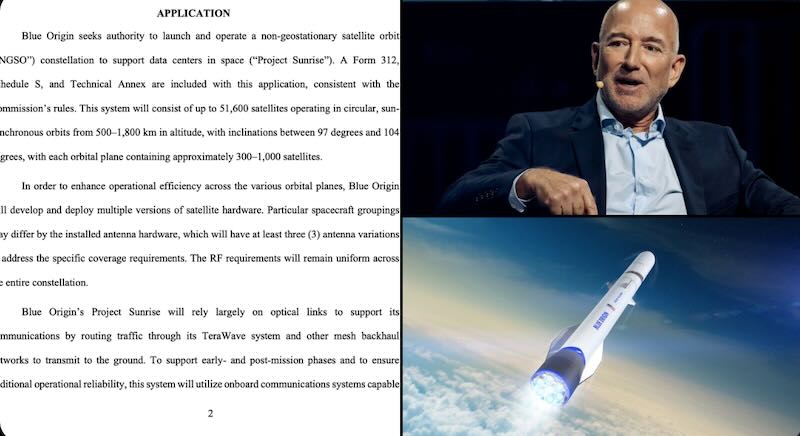
To move data between satellites and ground stations, Project Sunrise would rely primarily on optical inter-satellite links, essentially high-speed laser connections. Those laser links would integrate with TeraWave, 6 Tbps satellite network, Blue Origin’s planned Starlink competitor, though TeraWave itself hasn’t yet cleared FCC review. Filings are notably thin on hardware specifics, mentioning at least three antenna configurations but stopping short of detailing satellite size or compute capacity.
Blue Origin framed Project Sunrise as a competitive and environmental win. In its filing, the company argued that space-based compute capacity could ease pressure on Earth’s power infrastructure — including electricity grids and water systems typically strained by terrestrial data centers. “Encouraging diverse participation in the space-based data center market will catalyze advancements in technology and resource efficiency,” the company wrote.
That’s a pointed argument, particularly given the timing. Blue Origin simultaneously submitted a comment opposing SpaceX’s orbital data center plan, (SpaceX Buys xAI, valued at $1.25T, orbital AI data centers planned), warning that authorizing up to 1 million satellites would make it nearly impossible for multiple constellations to coexist. It’s a bold position from a company filing its own 51,600-satellite proposal, one that already dwarfs the roughly 15,000 active satellites currently orbiting Earth.
None of this comes without context. In October 2025, Jeff Bezos publicly described a future where humanity builds “giant gigawatt data centers in space” to harness solar energy for AI workloads. He predicted that space-based centers could eventually undercut terrestrial costs within a couple of decades.
Amazon, also a Bezos company — echoed similar concerns about SpaceX’s proposal to the FCC. The Commission’s chairman, Brendan Carr, publicly pushed back, suggesting Amazon should prioritize its own satellite broadband ambitions instead.
Whether regulators approve Project Sunrise, reject SpaceX’s proposal, or both, one thing’s clear: the battle for orbital dominance is only just getting off the ground.
Related Post
Elon Musk Abandons Mars for Moon in Major SpaceX Strategy Shift, Bezos Posted an Image of a Tortoise
Amazon Leo Satellite Internet Takes On Starlink With Three New Terminals, Launch Details
SpaceX Slams American Airlines Over Amazon Leo Talks, Starlink vs Leo Satellite Internet Battle